
Maintaining a comfortable and energy-efficient indoor environment is more than just a matter of setting the right thermostat temperature. If you’ve ever noticed that the upper floors of your building feel like a sauna while the ground floor remains chilly, or if your HVAC system struggles with freezing coils in the winter, you are dealing with temperature stratification in buildings.
This phenomenon occurs because air naturally organizes itself by density—warm air rises and cold air sinks. Without proper intervention, this leads to HVAC stratification, a persistent challenge that forces your systems to work harder, drives up energy costs, and leaves occupants uncomfortable. Learn more below, and contact Blender Products, Inc. today.

The Problem: Why Stratification Matters
In a standard HVAC setup, outdoor air and return air are brought together in an air stratification mixing box. However, air is surprisingly difficult to mix. Without specialized assistance, these two air streams can travel in parallel “layers” through your ductwork rather than blending into a uniform temperature.
This lack of air mixing to prevent stratification creates “cold spots” that can trigger freeze-stat trips or, worse, cause expensive heating and cooling coils to burst. It also results in inaccurate sensor readings, meaning your system is making decisions based on air temperatures that don’t reflect the actual environment.
The Solution: The Channel Blender
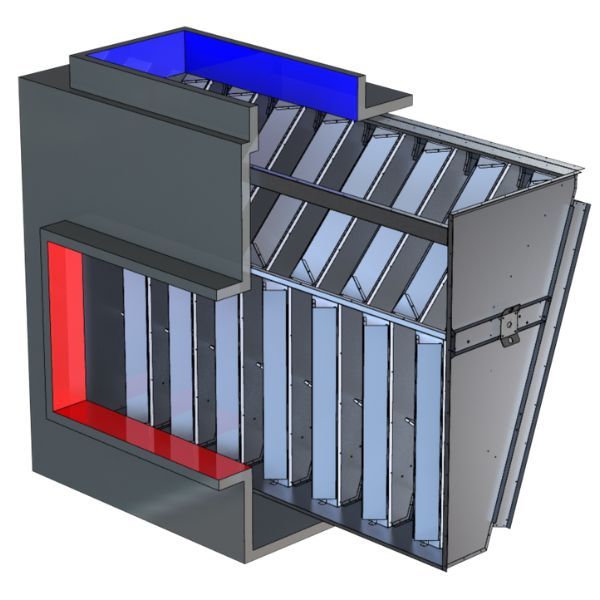
To solve these issues, you need high-performance air mixing equipment designed for the job. This is where the channel blender from Blender Products, Inc. makes a definitive difference.
Unlike traditional static mixers that might simply create turbulence, a channel blender is engineered to intercept the stratified layers of air and mechanically redistribute them. By utilizing a series of fixed directional vanes, the device forces the different air streams to cross paths and integrate thoroughly.
How It Transforms Your Building
By integrating a channel blender into your system, you achieve several critical benefits:
- Improved Air Quality: Uniformly mixed air ensures that fresh outdoor air is actually reaching all parts of the building, rather than staying trapped in a single “layer” of the airflow.
- Protection of Equipment: By eliminating the risk of frozen coils and nuisance trips, you extend the lifespan of your HVAC hardware and reduce emergency maintenance costs.

- Energy Efficiency: When your air is properly mixed, your sensors provide accurate data. This allows your system to run at peak efficiency, as it no longer has to overcompensate for hot or cold pockets.
- Occupant Comfort: You eliminate the “drafty” or “stuffy” zones that lead to employee complaints, creating a stable environment throughout the entire footprint of the facility.

CONTACT US TODAY
Proper ventilation isn’t just about moving air; it’s about managing it. With the right technology, you can turn a problematic, stratified system into a streamlined, efficient operation that protects both your budget and your comfort. Contact Blender Products, Inc. today.